Strong sunlight, dry wind, and high heat can place crops under stress. These conditions may raise water demand, scorch tender leaves, and affect young plants. An agricultural shade net helps growers manage light and create a more suitable crop environment without fully blocking the sun.
The right net depends on the crop, season, location, structure, and growth stage. Buyers should compare shade levels, fabric construction, UV stabilization, dimensions, and test information before ordering. When considering ShadoFlex as an agricultural shade net manufacturer, share your full application details and request a product specification. This guide explains the main options, uses, selection points, and installation practices.
What Is an Agricultural Shade Net?
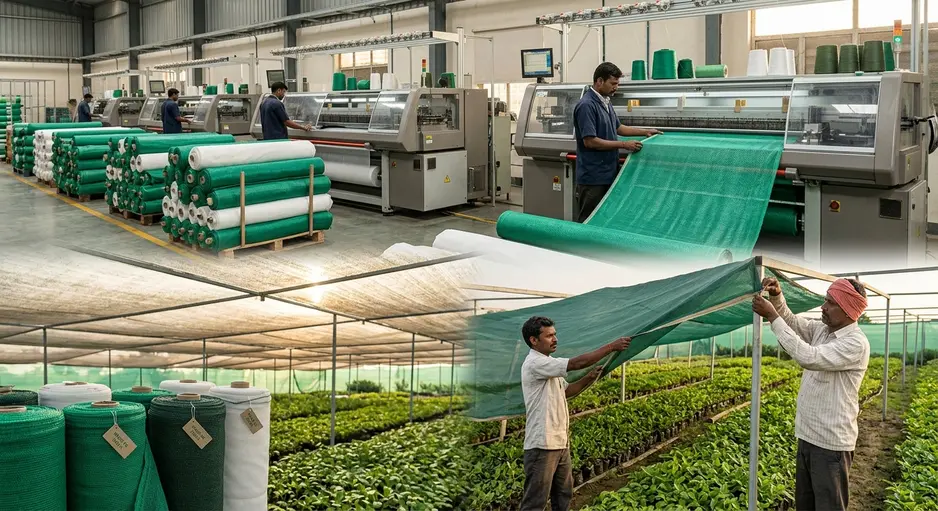
An agriculture shade net is a permeable fabric installed above or around crops. It reduces a selected portion of incoming light while allowing air to move through the covered area. Growers use it in nurseries, greenhouses, net houses, orchards, hardening areas, and some open-field applications.
How Agricultural Shade Netting Works
A properly selected net can support sunlight control and temperature regulation around plants. By reducing direct solar exposure and drying wind, it may also help with moisture retention. The result depends on the shade percentage, structure height, airflow, local weather, and crop canopy.
A UV stabilized shade net is designed to resist damage caused by long-term sunlight exposure. Standard netting may also provide partial protection from birds and light debris. However, it should not be presented as certified hail protection or insect control unless it has been designed and tested for that purpose.
Shade Net Compared With Other Crop Covers
- Shade net: Used for light reduction and heat management in nurseries, greenhouses, and fields.
- Insect net: Designed to restrict the entry of pests through openings in protected structures.
- Greenhouse film: Forms a more enclosed covering for polyhouses and greenhouses.
- Hail net: Designed to manage impact risks in orchards and other high-value crop areas.
Benefits of Shade Net for Agriculture
Sunlight Control and Temperature Regulation
A shade net for agriculture can reduce intense solar exposure during high-radiation periods. This may limit leaf scorching and help sensitive plants maintain a more stable growing environment. Results vary by crop and climate, so more shade does not always mean better performance.
Airflow remains important. A dense greenhouse shade net installed without enough ventilation may hold warm air inside the structure. Growers should plan shading and ventilation as one system rather than treating them as separate decisions.
Crop Protection and Moisture Retention
Dry wind can remove moisture from soil, growing media, and leaves. A suitable crop shade net may reduce wind exposure and slow evaporation. It can also provide a calmer setting for delicate nursery plants and newly transplanted crops.
Irrigation should be reviewed after installation. Water demand may change, but it will not fall by the same amount in every location. Soil type, humidity, crop size, drainage, and irrigation method still play key roles.
Support for Protected Cultivation
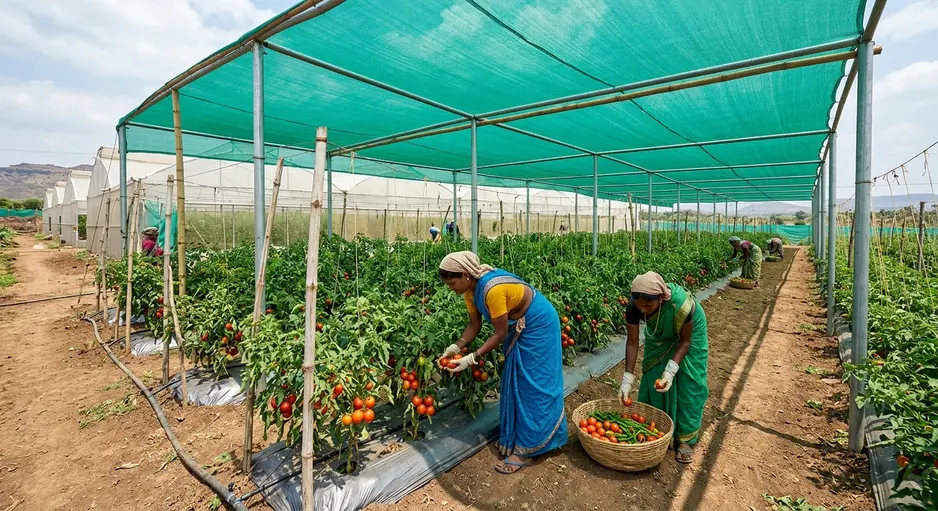
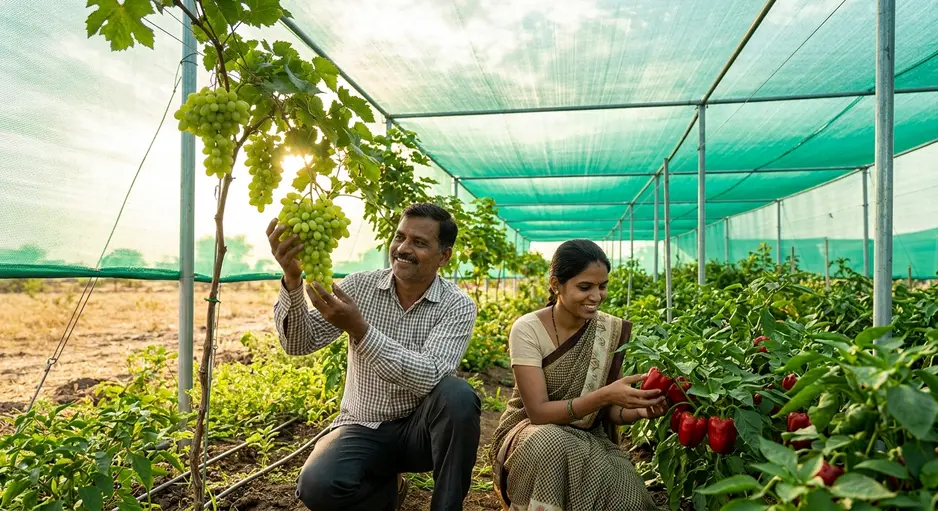
A horticulture shade net may be considered for vegetable cultivation, floriculture, seedling production, plant nurseries, hardening zones, orchard saplings, and high-value crops. It can be used as a roof, side covering, or part of a larger protected cultivation structure.
Which Shade Percentage Is Best for Crops?
Understanding Light Reduction Percentage
Shade percentage describes the approximate amount of incident light a net is designed to reduce under stated test conditions. For example, a 50% product is intended to reduce light by about half. Actual results in the field can differ.
Sun angle, net color, yarn design, fabric density, dust, installation tension, and measurement method can all affect performance. Folding or layering the material also changes light transmission and should not be used as a simple way to predict a final shade level.
General Shade Percentage Guide
- 30–35%: Often considered for sun-tolerant vegetables and selected open-field uses.
- 40–50%: Commonly evaluated for general nursery work, ornamentals, and selected vegetables.
- 50–75%: May suit propagation areas, shade-loving plants, and sensitive nursery stock.
- 75–90%: Usually reserved for specialized growing or non-crop shading applications.
These ranges are starting points, not universal crop prescriptions. Ask an agronomist or local agricultural authority to confirm the light needs of your crop, variety, season, and growth stage.
Is 50% Shade Net Good for Agriculture?
A 50% farm shade net can offer a practical balance between light reduction and the light needed for plant growth. It may suit some nurseries, vegetables, and ornamentals. However, it can be too dense for certain sun-loving crops and too light for highly shade-sensitive plants.
Why More Shade Is Not Always Better
Excess shade can lead to weak or elongated growth. It may also reduce flowering, fruit development, or yield in crops that need strong light. Dense covering combined with poor ventilation can create unwanted heat or humidity. A trial section is often safer than covering the full area at once.
HDPE, Knitted and UV-Stabilized Shade Nets
HDPE Monofilament and Tape Construction
HDPE shade net products may use monofilament yarn, tape yarn, or a combination construction. HDPE monofilament is often selected where strength and dimensional stability are important. Tape yarn can provide economical light reduction. Neither option is best for every site.
Buyers should compare yarn quality, net weight, fabric density, edge finish, and shade uniformity. A low price per square metre has limited value if the product does not match the structure or expected service conditions.
Advantages of a Knitted Fabric Structure
A knitted shade net is flexible and usually easy to handle during installation. Its looped construction can help limit progressive tearing after small, localized damage. Properly finished knitted material may also be prepared in custom sizes for larger agricultural structures.
Cutting methods and edge finishing still matter. Ask the supplier whether a cut edge needs reinforcement and which clips or fasteners are compatible with the fabric.
Why UV-Stabilized Material Matters
Long-term sunlight can weaken untreated plastic. UV stabilized material is intended to slow this process. Its working life will still depend on local UV exposure, polymer quality, additives, installation tension, wind, chemical contact, storage, and maintenance.
Do not rely on a general lifespan estimate. Request product-specific guidance and written warranty terms, including exclusions and required installation practices.
Does Shade Net Color Affect Performance?
- Green: Commonly associated with nurseries and agricultural structures.
- Black: Absorbs light and is often used for general shading.
- White or pearl: May provide a more diffused light environment.
- Specialized colors: Used for selected photoselective applications where crop evidence supports the choice.
Choose by verified shade factor and expected crop response rather than color alone.
How to Choose a Shade Net Manufacturer in India
Ask for Complete Technical Specifications
A reliable comparison starts with written product details. Before selecting a shade net manufacturer in India, request the following information:
- Material composition and yarn construction
- Shade percentage and permitted tolerance
- Net weight or GSM
- UV stabilization details
- Standard roll width and length
- Available colors and custom dimensions
- Edge finishing or eyelet options
- Recommended service conditions
- Relevant product test reports, where available
Review Manufacturing and Quality Control
Ask how the supplier checks shade density, knitting consistency, yarn quality, dimensions, and finished rolls. For repeat or bulk orders, batch traceability can help buyers manage quality. Packaging should protect the material during storage and domestic or export transport.
Compare Total Value, Not Just Price
The cheapest quotation may not provide the lowest long-term cost. Consider expected service life, installation waste, warranty limits, replacement availability, packaging, freight, lead time, and technical support. Confirm whether the quoted dimensions are finished dimensions and whether tolerances apply.
Questions to Ask a Shade Net Supplier in India
- Has the quoted shade percentage been tested?
- Is the material UV stabilized?
- Which specification is suitable for my crop and region?
- Can I inspect a sample before placing a bulk order?
- What are the minimum order quantity and production lead time?
- Are custom widths, colors, labels, or packaging available?
- Which installation practices are required for warranty coverage?
Agricultural Shade Net Applications
Nursery Plants and Seedling Production
A nursery in a high-radiation area may assess moderate shading to reduce midday stress while keeping enough light for compact plant growth. Shade-loving species and sun-tolerant seedlings will not need the same conditions.
- Match the shade level to the species and growth stage.
- Watch for plant stretch, pale leaves, or slow growth.
- Review irrigation after installing the covering.
- Keep the net clean for more predictable light transmission.
Greenhouse and Net-House Covering
External shading can reduce solar radiation before it enters a greenhouse. Internal systems may be easier to adjust in some structures. In both cases, ventilation must remain adequate. Avoid placing netting against hot, sharp, or abrasive surfaces that may damage the fabric.
Open-Field and Horticulture Uses
A shade net for farming may be installed over leafy vegetables, floriculture beds, new transplants, orchard saplings, or hardening areas. The support system must be planned for local wind conditions. The net should not rest directly on tender foliage unless the application has been designed for crop contact.
Wind and Hail Protection Limits
General agricultural shade netting may reduce some wind impact, but it is not a substitute for a designed windbreak where severe wind is the main risk. Standard shading material should not be assumed to provide hail protection. Hail-prone sites need a system designed for expected impacts and structural loads.
Installation and Maintenance Best Practices
Plan the Structure First
- Confirm post spacing and support-wire strength.
- Account for wind load and possible water accumulation.
- Maintain enough height and airflow around crops.
- Avoid overstretching the knitted fabric structure.
- Use smooth clips and fasteners that match the material.
Prevent Early Damage
Remove sharp edges from frames and reinforce high-stress points. Do not drag rolls over rough ground. Follow the recommended tension and avoid chemical exposure that has not been approved for the product. Store unused rolls in a clean, dry, sheltered area.
Inspect the Net Regularly
Check for loose fasteners, torn edges, sagging areas, dust buildup, frame corrosion, and storm damage. Early repairs can stop small problems from spreading.
Why Work With an Indian Shade Net Supplier?
Advantages for Domestic Buyers
Working with an Indian supplier can make communication, sample review, custom-order planning, and repeat procurement easier. Buyers can also discuss roll sizes and packaging based on local transport and installation needs.
Checks for Export and Bulk Orders
Bulk buyers evaluating a shade net exporter from India should confirm export packaging, roll labels, pallet details, loading plans, Incoterms, documentation, destination requirements, lead times, and production capacity before placing an order.
Contact ShadoFlex About Your Requirement
Contact ShadoFlex with your crop, location, growing season, structure type, preferred shade percentage, dimensions, and order quantity. Ask for a suitable specification, available test information, current lead time, warranty terms, and quotation. Providing clear application details will help the supplier review the request more accurately.
Agricultural Shade Net Manufacturer in India
Choose the Right Net for Your Growing Conditions
The right agricultural shade net depends on the crop, climate, shade factor, fabric construction, and installation method. Verify the material, light reduction percentage, UV stabilization, dimensions, test information, and warranty before ordering. Local agronomic guidance can help confirm the final shade level.
To discuss a project, contact ShadoFlex with your crop details, site conditions, structure dimensions, and required quantity. Request a clear technical specification and quotation before making your final selection.
Frequently Asked Questions About Agricultural Shade Nets
1. What is the best agricultural shade net?
The best option has a verified shade factor suited to the crop, climate, structure, and growth stage. UV stabilization, uniform construction, suitable dimensions, durability, and supplier support are also important.
2. Which shade level is best for a plant nursery?
Many nurseries consider levels from 40% to 75%, but there is no single answer. Seedlings, ornamentals, propagation stock, and shade-loving plants have different light needs. Local climate and season also affect the choice.
3. How long does an HDPE shade net last?
Service life varies with UV intensity, raw material quality, stabilization, wind, tension, chemical exposure, and maintenance. Ask for product-specific durability guidance and written warranty conditions.
4. Does agricultural shade net reduce temperature?
It can reduce direct solar load and moderate the crop environment. The actual change depends on shade density, color, structure height, airflow, humidity, and weather. A fixed temperature reduction should not be assumed.
5. Is knitted net better than woven net?
Knitted netting is flexible and can handle localized damage well. Woven products may suit other cost or strength needs. Compare weight, shade uniformity, dimensions, durability, and intended use rather than choosing by construction alone.