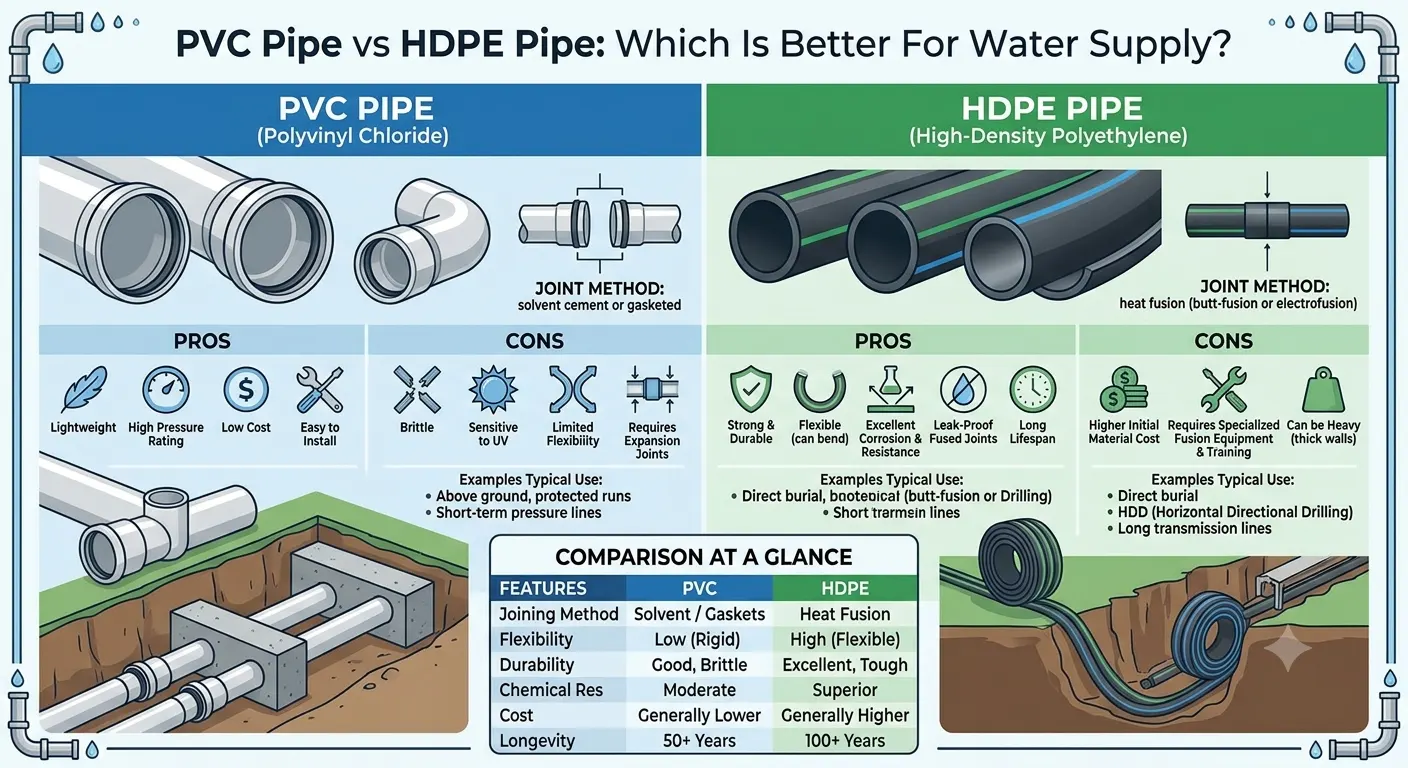
Choosing the right pipe for water supply is important for long-term performance, durability, and maintenance. Among the most commonly used options, PVC pipes and HDPE pipes are widely preferred for residential, agricultural, commercial, and industrial water supply systems.
Both materials offer unique advantages, but the better choice depends on the application, installation conditions, and water flow requirements. Understanding the difference between PVC and HDPE pipes can help buyers make the right decision.
What Is PVC Pipe?
PVC (Polyvinyl Chloride) pipe is a lightweight and rigid plastic pipe commonly used in plumbing and water distribution systems. It is popular because of its affordability, easy installation, and corrosion resistance.
Key Benefits of PVC Pipes
- Lightweight and easy to install
- Cost-effective for residential projects
- Rust and corrosion resistant
- Smooth internal surface for better water flow
- Low maintenance requirements
PVC pipes are commonly used in homes, irrigation systems, and underground water supply lines.
What Is HDPE Pipe?
HDPE (High-Density Polyethylene) pipe is a flexible and highly durable plastic pipe designed for high-performance water transportation. It is widely used in industrial, agricultural, and municipal water supply systems.
Key Benefits of HDPE Pipes
- Strong flexibility and impact resistance
- Leak-resistant joints
- Suitable for underground applications
- Excellent weather and chemical resistance
- Long service life
HDPE pipes are preferred for large-scale water supply projects and areas with changing ground conditions.
PVC Pipe vs HDPE Pipe Comparison
|
Feature |
PVC Pipe |
HDPE Pipe |
|
Material Type |
Rigid Plastic |
Flexible Plastic |
|
Durability |
Good |
Excellent |
|
Flexibility |
Low |
High |
|
Installation |
Easy |
Moderate |
|
Leak Resistance |
Moderate |
High |
|
Corrosion Resistance |
Excellent |
Excellent |
|
Pressure Handling |
Moderate |
High |
|
Lifespan |
25–40 Years |
50+ Years |
|
Cost |
More Affordable |
Slightly Higher |
Which Pipe Is Better For Water Supply?
Both PVC and HDPE pipes are reliable for water supply, but the better option depends on the project type.
Choose PVC Pipe When:
- Budget is a major concern
- The project is residential or small-scale
- Easy installation is required
- Straight pipeline layouts are used
Choose HDPE Pipe When:
- Long-term durability is important
- Underground or industrial installation is needed
- High water pressure systems are involved
- Flexibility and leak resistance are priorities
HDPE pipes generally offer better long-term performance for large infrastructure and industrial water supply systems. PVC pipes remain a practical and economical solution for many residential and agricultural applications.
Conclusion
PVC and HDPE pipes both play an important role in modern water supply systems. PVC pipes are affordable, lightweight, and suitable for residential use, while HDPE pipes provide higher durability, flexibility, and leak resistance for demanding applications.
The right choice depends on installation conditions, project size, water pressure requirements, and long-term maintenance expectations. Selecting high-quality pipes from a trusted manufacturer helps ensure reliable water supply performance for years.